Have you ever wondered why plants grow well in fertile soil or how animals get the nitrogen they need to make proteins and build tissues? The answer lies in one of nature’s most important recycling processes—the nitrogen cycle.
Nitrogen surrounds us. About 78% of Earth’s atmosphere consists of nitrogen gas (N₂). We breathe it in with every breath, and it exists in the air, soil, water, plants, animals, and microorganisms. Yet, there is an interesting problem. Most plants and animals cannot use atmospheric nitrogen directly.
Nitrogen gas has a very strong triple bond between its two nitrogen atoms (N≡N). This bond makes nitrogen highly stable and difficult for most organisms to break. As a result, nitrogen can remain abundant in the atmosphere while living organisms still struggle to obtain it in a usable form.
But life cannot function without nitrogen.
Nitrogen forms an essential part of proteins, enzymes, nucleic acids such as DNA and RNA, and ATP. Every living cell needs nitrogen to grow, reproduce, and carry out its normal activities. So how does nitrogen move from the atmosphere into living organisms?
This is where the nitrogen cycle comes into the picture.
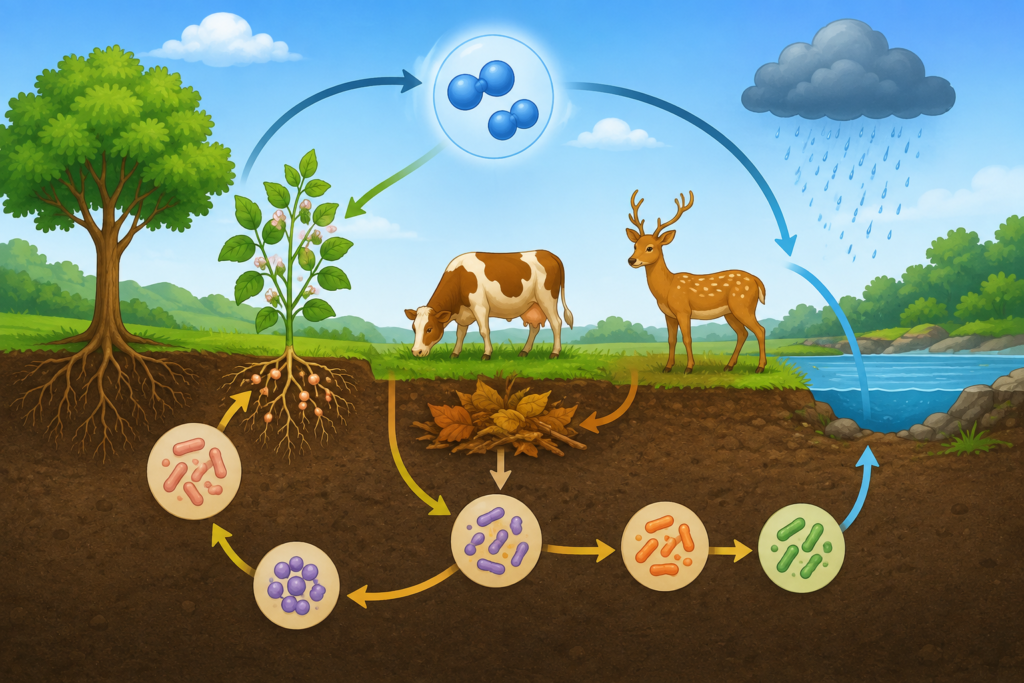
The nitrogen cycle describes the continuous movement of nitrogen between the atmosphere, soil, water, plants, animals, and microorganisms. During this cycle, microorganisms transform nitrogen from one chemical form into another. These transformations make nitrogen available to plants and eventually to animals.
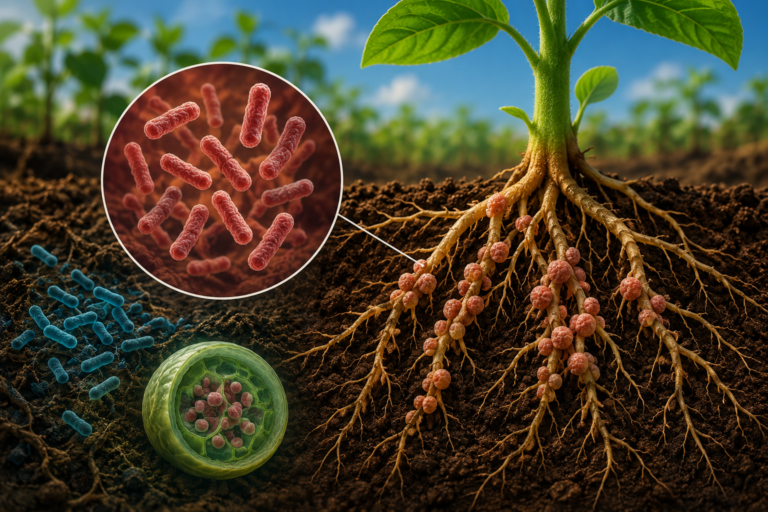
Microorganisms play a central role in this process. Certain bacteria can capture atmospheric nitrogen and convert it into ammonia. Other microorganisms convert ammonia into nitrite and then nitrate. Plants can absorb nitrate and, in some cases, ammonium from the soil and use these nitrogen sources to make proteins and other nitrogen-containing compounds.
Animals obtain nitrogen mainly by eating plants or other animals. When plants and animals die or release waste, microorganisms break down the organic matter and return nitrogen to the soil. Other microorganisms can then transform this nitrogen into different forms that plants can use again.
Eventually, some bacteria convert nitrate back into nitrogen gas. This process returns nitrogen to the atmosphere and completes an important part of the cycle.
In this way, nitrogen constantly moves through the environment. The nitrogen atoms in a plant today may have once existed in an animal, a microorganism, or even the atmosphere. Nature continuously recycles them instead of allowing this essential element to remain locked in one place.
The nitrogen cycle shows us why microorganisms matter so much to life on Earth. These tiny organisms perform chemical transformations that larger organisms cannot carry out on their own. Although we cannot see them with our naked eyes, their activities influence soil fertility, plant growth, ecosystems, and the availability of an element that every living cell needs.
So, the nitrogen cycle is much more than a microbiology topic. It is nature’s way of recycling one of the most important building blocks of life.
The next time you see a healthy green plant, remember that countless microorganisms may have played a role in making its nitrogen available.
And perhaps the most fascinating part is this: some of the nitrogen atoms present in your body today may have passed through countless living organisms before becoming part of you.