Nitrogen is one of the most important elements required for life. Plants need nitrogen to make proteins, nucleic acids, chlorophyll, and many other essential compounds. Animals and humans ultimately depend on plants and other organisms for nitrogen.
Although the atmosphere contains a large amount of nitrogen gas, most organisms cannot use atmospheric nitrogen directly. Atmospheric nitrogen mainly exists as nitrogen gas (N₂), and the two nitrogen atoms hold each other together through a very strong triple bond.
Nitrogen fixation solves this problem. During nitrogen fixation, atmospheric nitrogen changes into ammonia or other nitrogen compounds that living organisms can use.
Nitrogen fixation occurs through three major processes: biological nitrogen fixation, physical fixation, and industrial nitrogen fixation. Among these, biological nitrogen fixation plays a particularly important role in natural ecosystems.
What Is Nitrogen Fixation?
Nitrogen fixation is the conversion of atmospheric nitrogen gas (N₂) into ammonia (NH₃) or related nitrogen compounds.
Certain microorganisms carry out this process with the help of an enzyme called nitrogenase. Nitrogenase uses electrons and a large amount of energy from ATP to break the strong triple bond in nitrogen gas.
The overall reaction can be represented as:
N₂ + 8H⁺ + 8e⁻ + 16 ATP → 2NH₃ + H₂ + 16 ADP + 16 Pi
This reaction requires considerable energy. The microorganism supplies that energy through ATP generated by its metabolism.
Once microorganisms produce ammonia, the ammonia can react with water and form ammonium ions (NH₄⁺). Under normal soil conditions, nitrogen often exists mainly in the ammonium form rather than as free ammonia.
Plants can take up ammonium and use it to produce amino acids, proteins, and other nitrogen-containing compounds.
Biological Nitrogen Fixation
Biological nitrogen fixation occurs when certain microorganisms convert atmospheric nitrogen into ammonia.
The enzyme nitrogenase performs the central reaction. However, nitrogenase has one major weakness: oxygen can damage its activity. Microorganisms that fix nitrogen therefore need ways to protect nitrogenase from oxygen.
Different microorganisms have developed different strategies to solve this problem.
Biological nitrogen-fixing microorganisms generally fall into two broad groups: free-living nitrogen-fixing microorganisms and symbiotic nitrogen-fixing microorganisms.
Free-Living Nitrogen-Fixing Bacteria
Free-living, or non-symbiotic, nitrogen-fixing bacteria live independently in soil or other environments. They do not need to live inside plant tissues to fix nitrogen.
Examples include Azotobacter, Clostridium, Beijerinckia, Azospirillum, and nitrogen-fixing cyanobacteria such as Anabaena and Nostoc.
Azotobacter grows aerobically and commonly occurs in neutral soils. Clostridium contains anaerobic species that can fix nitrogen under oxygen-free conditions. Beijerinckia includes aerobic nitrogen-fixing bacteria, while Azospirillum commonly associates with the rhizosphere of grasses and cereals.
Cyanobacteria such as Anabaena and Nostoc also contribute to nitrogen fixation, particularly in aquatic and moist environments.
These microorganisms obtain nitrogen gas from their surroundings and use nitrogenase to convert it into ammonia. They use some of the fixed nitrogen to make their own cellular components. When they release nitrogen compounds or die and decompose, they contribute nitrogen to the surrounding environment.
How Do Aerobic Bacteria Protect Nitrogenase?
Oxygen creates a major challenge for aerobic nitrogen-fixing bacteria because nitrogenase works poorly in the presence of oxygen.
Azotobacter, for example, uses several mechanisms to protect nitrogenase. It can maintain a high rate of respiration that helps consume oxygen rapidly around the nitrogenase system. It can also produce protective extracellular materials that help limit oxygen exposure.
Some nitrogen-fixing cyanobacteria use another interesting strategy.
Certain cyanobacteria form specialized cells called heterocysts. These cells provide a relatively oxygen-limited environment where nitrogen fixation can occur. Heterocysts have thickened cell envelopes and specialized metabolism that helps protect nitrogenase from oxygen.
This adaptation allows the cyanobacteria to carry out photosynthesis and nitrogen fixation within the same organism while reducing the harmful effect of oxygen on nitrogenase.
Symbiotic Nitrogen Fixation
Some nitrogen-fixing microorganisms live in close association with plants. Both partners benefit from this relationship, which makes it a symbiotic relationship.
The best-known example involves Rhizobium and leguminous plants such as peas, beans, clover, and lentils.
Other nitrogen-fixing microorganisms form associations with different plants. Frankia, for example, forms symbiotic relationships with certain non-leguminous plants such as Alnus and Casuarina. Anabaena forms an important nitrogen-fixing association with Azolla, a floating water fern.
How Does Rhizobium Form Root Nodules?
The relationship between Rhizobium and legumes involves a fascinating series of interactions.
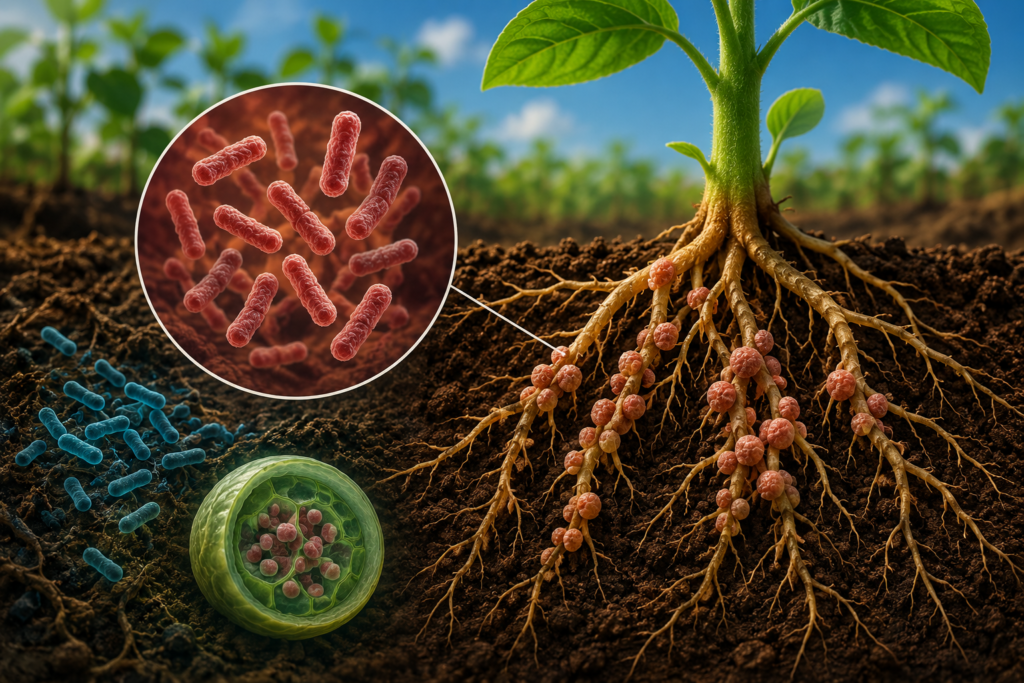
When a legume experiences a need for nitrogen, its roots release chemical compounds called flavonoids into the surrounding soil. Compatible Rhizobium bacteria detect these compounds and respond by producing signaling molecules called Nod factors.
The Nod factors cause changes in the plant root hairs. The root hair curls around the bacteria, and the bacteria enter the root through a structure called an infection thread.
The infection thread acts as a pathway through which the bacteria move deeper into the plant root.
The plant then develops small structures called root nodules. These nodules function as specialized sites where nitrogen fixation takes place.
Inside the plant cells, the bacteria undergo major changes and develop into specialized forms called bacteroids. The host plant controls much of this transformation.
The bacteroids contain nitrogenase, which converts atmospheric nitrogen into ammonia using ATP and reducing power.
The Role of Leghemoglobin
The root nodule provides a carefully controlled environment for nitrogen fixation.
Nitrogenase cannot function efficiently when exposed to high levels of oxygen. At the same time, the plant and the bacteria need oxygen for respiration and energy production.
The plant solves this problem with a fascinating molecule called leghemoglobin.
Leghemoglobin occurs in legume root nodules and has a reddish color because it contains heme. It binds oxygen and helps maintain a low concentration of free oxygen around the nitrogen-fixing bacteria.
This controlled oxygen environment allows the bacteria to obtain enough oxygen for their energy requirements while protecting nitrogenase from excessive oxygen exposure.
The pink or reddish color of an active legume root nodule often indicates the presence of leghemoglobin.
How Do Plants and Bacteria Benefit Each Other?
The relationship between the plant and the nitrogen-fixing bacteria works in both directions.
The bacteria convert atmospheric nitrogen into ammonia through nitrogen fixation. The plant quickly incorporates the fixed nitrogen into compounds such as amino acids and other organic nitrogen molecules.
In return, the plant supplies the bacteria with carbohydrates and other nutrients. The plant also provides the bacteria with a protected environment inside the root nodule.
Therefore, both partners gain an advantage from the relationship.
The plant receives a usable source of nitrogen, while the bacteria receive energy-rich nutrients and a suitable environment for growth and nitrogen fixation.
What Happens to Fixed Nitrogen in Soil?
Nitrogen fixation does not end with the production of ammonia.
Plants incorporate the fixed nitrogen into organic molecules and use it for growth. Animals obtain nitrogen by consuming plants or other organisms.
When plants and microorganisms die, decomposers break down their organic matter and return nitrogen compounds to the soil.
Some of the fixed nitrogen eventually becomes available to other plants. Other microorganisms transform these nitrogen compounds through processes such as nitrification and denitrification, which form important parts of the nitrogen cycle.
This continuous movement of nitrogen allows ecosystems to recycle this essential element.
Why Is Nitrogen Fixation Important?
Nitrogen fixation supports life by making atmospheric nitrogen available in biologically useful forms.
Without nitrogen fixation, plants would have much less access to usable nitrogen, and this would affect the entire food chain.
Nitrogen-fixing microorganisms also contribute to soil fertility. Leguminous crops such as beans, peas, and other pulses can form associations with nitrogen-fixing bacteria and add biologically fixed nitrogen to agricultural systems.
For this reason, farmers often include legumes in crop rotations. Growing legumes can help improve soil nitrogen availability and reduce the dependence on external nitrogen inputs.